
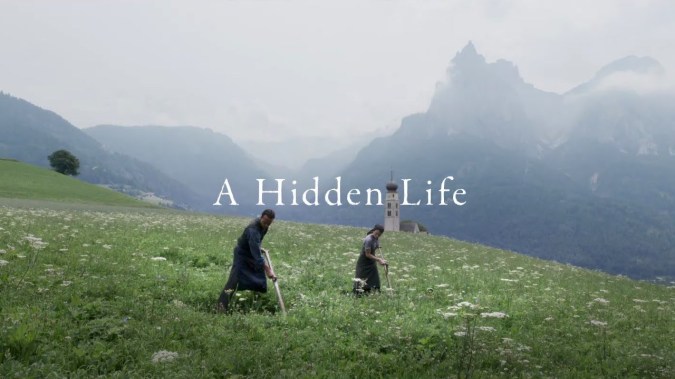
 For those who imagine what would have happened if the SS monsters chasing The Von Trapp family in The Sound of Music had captured them in the Abbey’s graveyard, Terrence Malick’s latest virtuosic film, A Hidden Life offers a possible answer, if Captain Von Trapp had stuck to his convictions.
Winner of the Ecumenical Jury Award at the Cannes Film Festival, A Hidden Life is based on the true story of Franz Jäggerstätter, (August Diehl) an Austrian farmer, WWII conscientious objector, and Christian martyr. After receiving mandated military training, Jäggerstätter refused to swear an oath of allegiance to Adolph Hitler, as was required of everyone serving in the German Armed forces. Though he offered to serve the nation that absorbed his homeland as a non-combatant medic, to the German High Command he was a traitor because he refused to pledge loyalty, not to a nation, but to the leader of that nation.
 Although filmed in the Dolomite Mountains of Italy, A Hidden Life depicts the lush pastoral countryside and village of St. Radegund Austria, the home of Franz, his wife Franziska (Valarie Pachner) and his young daughters. Malick does not let any of the indescribable beauty of the Alps go to waste. Cinematographer Jörg Widmer captures the area in such a way that the viewer has the sense they are at one with the landscape and therefore experience a greater connection to the story and film. With but a bit of imagination, the viewer feels both the flowing beauty and peace of the setting.
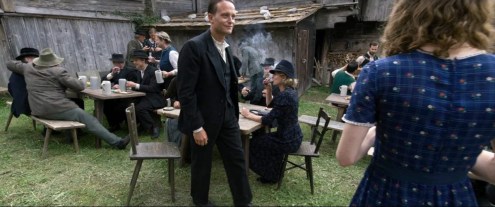 The viewer might also experience the simple, communal, and peaceful life of St. Radegund as presented at the beginning of the film. Initially, the community was close nit as families cared for and worked with one another to make a life together and help supply food and dairy products for the nation. This bucolic life and sense of community, however, falls victim to the Anschluss of Austria into Germany on March 12th, 1938 and the beginning of World War II.
Unlike most war films that show the massive destruction war inflicts on cities, towns, and homes, St. Radegund is spared from the physical destruction of the war, but it does not escape the destruction of the sense of community that made it such a special place for the inhabiting families. As if to symbolize human responsibility for the horrific destruction of war, the preservation of the pristine, natural beauty of St. Radegund and the surrounding region makes the human ugliness of the war stand out even more.
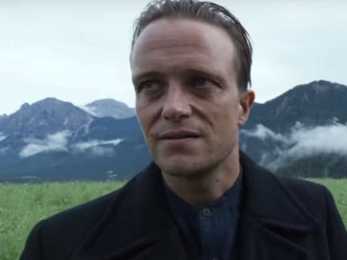 As he did with the scenery, the director also focuses on the characters. In contrast to the vastness of the pastures and mountains, Malick frequently photographs the individuals in tight shots, seemingly violating personal space boundaries. Such intimacy in shot selection symbolizes the personal nature and effects of the characters’ decisions and actions. The technique also pulls the viewer further into the narrative, making them more of a witness than a distant, disconnected observer.
As his village experiences and gives into the first winds of war, Franz seeks to stand against the gale. After first opposing the annexation of his country, Franz then opposes the brutality German fascism inflicted upon the Jewish population in Austria and others who were designated “different.” As the majority of St. Radegund favored the annexation of their country and village into Germany, Franz also opposes the marginalization and antipathy of life-long friends against him, his wife, and even his children. Lastly, Franz Jäggerstätter has to decide whether to maintain his beliefs or surrender to pleas and even taunts from others for him to go against his beliefs and swear an oath to Hitler.
While he consults the village priest, for whom he served as an assistant in the village’s church, as well as the area Bishop, Franz has to decide for himself whether he will 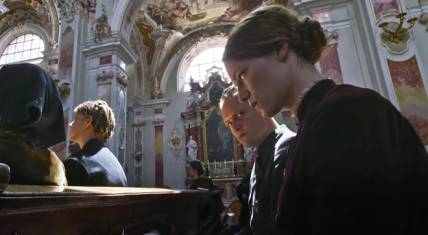 adhere to his belief, or declare, if only in words, the allegiance. For Franz, this decision amounts to whether he will remain righteous or oppose God’s desire for him. Despite all he has to lose, and the impact of his decision upon his family, Franz decides righteousness and responsibility to God surpasses all other calls and responsibilities in life.
In the twelfth chapter of the Gospel of John, Jesus enters Jerusalem. Very soon after he entered the capital city on what is now celebrated as Palm Sunday, Jesus received word from two of his disciples that there were some Greeks who wanted to meet him. As with many others in the city, they heard that Jesus had raised Lazarus from his grave four days after he had died and been buried (Ch. 11.) Upon hearing this request, and perhaps within earshot of the others wanting to meet the One who could restore life to the dead, Jesus spoke about his future as well as the future and expectation for those who would follow Him: 25 Those who love their life lose it, and those who hate their life in this world will keep it for eternal life. 26 Whoever serves me must follow me, and where I am, there will my servant be also. Whoever serves me, the Father will honor.
For most people watching the A Hidden Life, this teaching of Jesus calls them to give up comforts, habits or fears that keep them from living a righteous life of faith in Jesus rather than the perceived protection and comfort of worldly power and authority. Although there are people today for whom this passage is a matter of life and death, for most viewing the film it is a matter of Dietrich Bonhoeffer’s teaching to die to oneself, by putting to death personal desires and distractions that lead one away from God.
 Franz Jäggerstätter took John 12:25-26 and other teaching and life examples of Jesus and early followers with most seriousness as he believed that to swear an oath, if only in word, to Adolph Hitler was to join the Peter by the campfire when the Apostle denied his Lord. For Franz, the issue was less about losing his salvation than about betraying his creator and redeemer. Though he became known for his struggle and sacrifice, the title of the film acknowledges Franz was not alone in his decision. Through the centuries there have been many hidden lives that chose righteousness over life in this world.
 Throughout the film, Franz resisted offering judgment against those who had given their loyalty to Hitler. It was a personal matter and decision. For Franz, his resistance mattered because he believed it mattered. In his heart, he believed that to offer his loyalty to Hitler was to take it from Jesus. If others did not agree with his belief, Franz withheld judgment. This refusal to judge others extended beyond the screen and into the theater. It is difficult to imagine anyone could watch the film without asking, “What would I do?” As the viewer asks and considers this question while watching Franz wrestle with his dilemma, one senses Franz would call the viewer not to do what he is doing, but to do what the viewer, after intentional discernment, believes God desires them to do.
While the film may not judge those who believe righteousness would not prevent them from offering a hollow, disingenuous allegiance to worldly leaders and then work to serve their God in others ways, one does feel the film offers judgment against those who do what they know is wrong for convenience or safety’s sake.
As A Hidden Life is released in a time when there is much discord and challenges for citizens and leaders to consider their beliefs and actions in accordance with cherished principles and laws, the actions of Franz Jäggerstätter challenge and call individuals and nations to genuinely consider what is righteous and then hold fast to their discernment and conscience.
 Although he has a devoted following, Terrence Malick is not every film lover’s cup of tea. As much as any working director, viewers either take or leave Malick’s films, and A Hidden Life, will prove to be no exception. Whether it is the challenging nature of the story or the slowly evolving, three-plus hours length, there will be many for whom this bell will not toll. But for those who appreciate or savor deeply personal storytelling, superb Oscar-worthy acting, and unsurpassable cinematic beauty, A Hidden Life is not a film to miss.
A Hidden Life Opens on December 13th 2019 and is rated PG-13


 investigative reporter, Vogel is resistant to accept the assignment to interview a man who is known for his sugar-sweet children’s TV program. Later, Vogel discovers that all of the other “Hero” subjects refused to allow him to interview them because of his reputation for attacking the subjects of his stories. Mr. Rogers not only agreed to allow Vogel to do the interview but Rogers sought him out.
 In order to be able to love a neighbor, one has to take time to see and get to know them. Where the other Heroes of the Esquire spread saw Vogel as an attack journalist who wrote with a laptop as well as a hatchet, Rogers saw Lloyd as someone living an angry, pain-filled life. Taking the time to literally read between the lines, Rogers saw in Lloyd someone who had life-wounds that were still raw. Upon recognizing this anger and injury, Mr. Rogers shared more than just information about himself with Vogel, he shared himself by establishing a relationship with Lloyd. As with any friendship, Fred took a risk in sharing who he was and what he believed. One of the most important depictions of “Beautiful Day” was Fred Rogers had the rare attribute that he was what he believed. And, what Fred believed was that all persons are special children of God who deserve to be loved and cared for, especially when they are wounded and even angry. For Fred, and all persons of faith, a difficult personality or situation does not release one from their duty to care for others and in doing so, share God’s peace.
 In addition to a commitment to love one’s neighbors whether they be next door, family, friends, strangers, and even enemies, A Beautiful Day in the Neighborhood also depicts Fred Rogers’s living a peace-filled and peace-filling life. While many, including Lloyd, assume that the persona of Mister Rogers is a role for Fred Rogers, Lloyd and the audience discover that the man and the character are the same. Fred Rogers truly lives life at peace, even in the midst of a world that is so often in conflict. Put in a theological perspective, Fred lives a life of Shalom, peaceful wholeness even in the midst of tremendous conflict and uncertainty.
 By risking and reaching out to someone he knew was struggling, Fred Rogers helped Lloyd
 subtlety. Fleck is a down on his luck clown for hire and wannabe comedian struggling against poverty, crime, the cruelty of others, as well as his and his mother’s mental illnesses. Arthur is just on the edge of functioning and his mother (Francis Conroy) is just over the edge. For Arthur and his mother, if past and present are prologues, their future is utterly void of light and hope. As the story develops it is evident the majority of the Gotham’s citizens are “have-nots” also succumbing to the downward pull of the city.
 In Joker, Chaplin’s Modern Times is shown as part of a High Society, Gala. The irony is hard to miss as “The Rich” of Gotham City gather in an exquisite theater, their laughter at the “Tramp” literally skating on the verge of disaster is set against the shouting of protestors whose anger is on the verge of boiling over into rage. Through these two references, Todd Phillips is stating “that’s life” in Gotham, as well as our modern time and place.
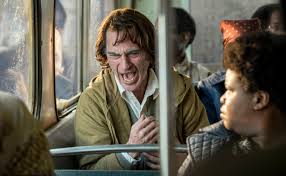 Through Arthur, Todd Phillips is lifting up the tendency in our modern time to blame individuals for their mental illness. Such culpability often results in individuals not seeking treatment, living under the stress of acting as if they do not have their illness and then being judged when their illness is manifest. This stress often magnifies the symptoms and maladaptive behavior resulting in a cycle of stress, flair-ups, judgment, and more stress.
 likewise failed to protect Arthur as a child or provide effective care and therapy for him as an adult. During one of his social work
  condemnation rather than blessings of concern and care to Arthur and others who are vulnerable and suffering, Wayne and all of Gotham experience the woes of their indifference through the rise of Joker and his disciples. Phillips concludes the film by punctuating this reality of woe with the reprise of “That’s Life.”



 As Elton John struggled with his identity through his early adult through middle age years, “Rocketman” wrestles with its genre and purpose. Is the film a celebration of the music of an iconic artist and pop-culture figure, or is it a story that offers greater insight into the man behind the costumes and eyeglasses. In trying to be both, each part, and the film as w whole is diminished.
 Those who are looking for experiential insight into the music, and men whose partnership created one of pop music’s preeminent catalogues, will likely be more disappointed in the film. Viewers will leave with only a cursory awareness that Reggie Dwight was considered a musical prodigy, that he came from a dysfunctional home where he was emotionally neglected save for love given to him by his grandmother, and he spent much of his life trying to fill that void. For fans and those familiar with Elton’s biography, this is not news.
 After being diagnosed and treated for AIDS, Ryan and his family were shunned by the School district, their church and many residents and businesses in the community. Upon hearing of their struggles Elton reached out to the family and developed a relationship with Ryan and his mother Jeanne. Elton was with Ryan when he died and sung one of his and Taupin’s earliest songs, Skyline Pigeon at Ryan’s 1990 funeral. Elton credits Ryan and Jeanne for helping inspire him to finally achieve and maintain sobriety.
 Taron Egerton (Kingsmen: The Secret Service) resembles John in both look and singing without coming across as trying and for an exact imitation.
 In spite not reaching its intended orbit, watching Rocketman is an enjoyable experience, especially for those who experienced the music, the times, and the celebrated life of the former Reginald Kenneth Dwight.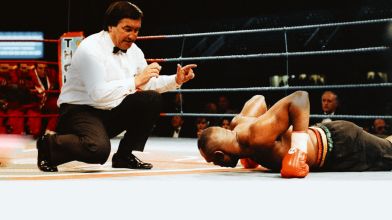
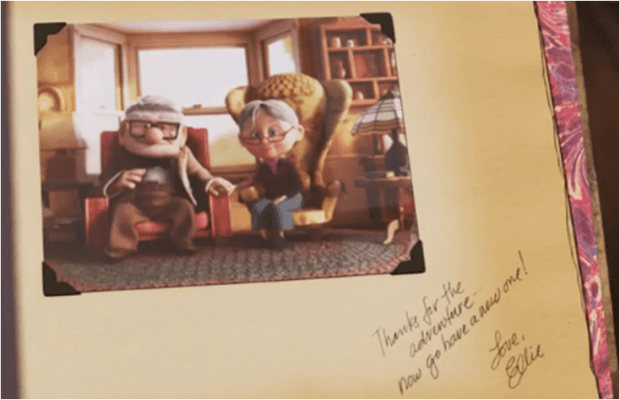
 To people of the Christian faith, each episode speaks to the nature and differences of the worldly life we were born in to and the Kingdom life to which we are called and into which we are baptized. As is repeated throughout Scripture, those who are considered losers, or that which is considered losing in the judgment of the world, are often winners in God’s criteria and Kingdom. This reality is repeated again and again in the teaching, life, and ministry of Jesus as well as Paul and others.
 For each of the subjects, losing was not what they desired or thought to be good. But in each, losing opened them to experiences ultimately more meaningful and satisfying than the temporary enjoyment and notoriety that winning would have brought them. One example of such is the story of French Golfer Jean van de Velde, who after losing a three-shot lead on the final hole of the 1999 Open Championship (British Open) and along with that the honor of having his name inscribed on the famous Claret Jug. Instead, he ended up having his name inscribed on the hearts of many of the young French golfers he later inspired and coached, as well as the lives of children he impacted through his work with UNICEF. Had he won the Open, it is less likely he would have been able to devote attention and time to these causes.
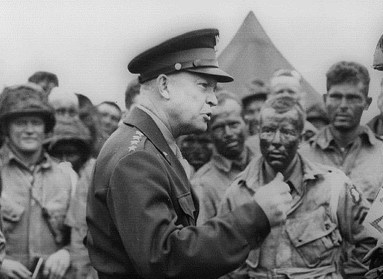 This 16-minute speech is President Dwight Eisenhower’s farewell address to the nation. As supreme allied commander in Europe during World War 2, Dwight Eisenhower bore as heavy a responsibility as anyone in the 20th Century. This, one of his final acts after 50 years of service to the nation is very much worth the time to watch.
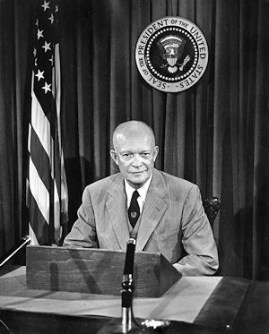 Known as the “Military Industrial Complex” speech, President Eisenhower’s farewell address goes far beyond that issue in addressing the challenges the nation would, and we now face. Central to his call is the place of statesmanship and the need for balanced cooperation between the private and public sphears. He also challenged the nation to resist the temptation to use fear as a tool of governing and put the needs of the nation above personal and partisan benefit. Perhaps he was not in touch with the time of Camelot, but this speech shows Eisenhower was very much in touch with the challenges facing our nation through the ages.
 Won’t You Be My Neighbor offers a contrasting voice and message to what fills the air today. The film is not obvious in pointing out the differences; it doesn’t have to be. There was an audible murmur when they showed tape from the first week of the program in 1968. The video showed the puppet character King Friday the XIII fearing the “Changers” and requiring reluctant subjects to build a wall to keep out people who wanted to bring change to his Kingdom. The clip ended with the human Lady Aberlin sending balloons with “signs” calling for peace and acceptance of others over the wall to the King.
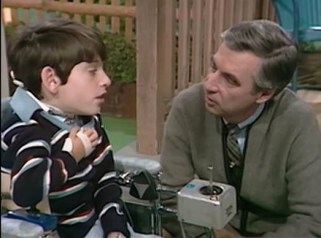 Even though Fred Rogers was an ordained Presbyterian minister, he never mentioned it on the air and rarely in public. Rather than talking about credentials and ministry, Fred presented the face of Christ to children and families throughout the country and ages.
 Fred Rogers also addresses the issue of race. A week after there were news reports and film of a hotel owner chasing African Americans out of the hotel pool by pouring bleach into the water to “clean” it, the neighborhood of Mr. Rogers saw him sharing a footbath with Officer Clemmons, portrayed by Francois Clemmons, an African American member of the cast. There was no mention of the hotel incident. there did not have to be.
 Based on a true story, A Beautiful Day in the Neighborhood depicts Mr. Rogers relationship with, and ministry to a Vanity Fair writer assigned to write an article on him. Tom Hanks as Mr. Rogers in the film which opens on November 22.
 I thought I would review The Shape of Water, the winner of the 2018 Academy Award for Best Picture in a different way, a text log between me and my niece.
 Me: People/govt. afraid of difference in others…other people united, by what makes them different…Allowing what unites them to overcome their difference.
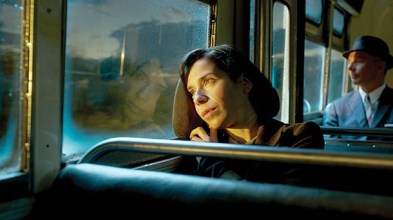 Me: I thought Sally Hawkins’s performance was extraordinary…
 In addition to the Best Picture Oscar, Guillermo del Toro won the Oscar for Best Direction. The Shape of Water is a beautifully photographed film where the acting is just as impressive, and as with most fantasy films, The Shape of Water allows, if not demands for continued contemplation and application to one’s life and circumstance. It’s not a film everyone will relate to or enjoy, but it was worthy of winning the Best Picture award.

