
Apple tv+
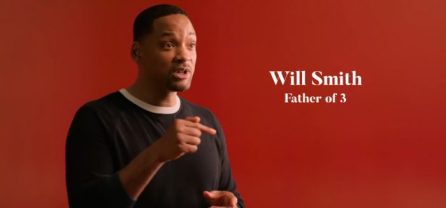
“Dads” is an engaging recognition and celebration of modern fatherhood. Directed by Bryce Dallas Howard, celebrities including Ron Howard, Will Smith, Conan O’Brien, Jimmy Fallon, Kenan Thompson, Neil Patrick Harris, and Hasan Minhaj, among others reflect on the impact becoming and being fathers had on their lives. These reflections are interspersed around powerful, more in-depth stories of everyday men and how fatherhood changed their lives as well. “Dads” premieres on Apple +TV on June 19th and is a partnership between Imagine Documentaries, and Dove Men+Care. Unilever, Dove Care’s parent company is supporting fatherhood and has established the Paternity Leave Fund which offers grants to fathers who do not receive paid paternity leave. Dove Men+Care is donating a portion of the proceeds of “Dads” to this fund.
“Dads” includes the humor every new father encounters when he makes the transition from being the son of a father and mother to being the father of a son or daughter. These stories and scenes are funny and endearing, but what gives “Dads” its fullness are the  powerful stories of how the lives of the men were transformed through their presence and active role in parenting their children. Another source of the film’s richness is the diversity of fathers and families. In addition to the mix of celebrities and fathers who are not famous, there is diversity in economic and marriage statuses, nationality and cultural background, sexual orientation, and the health of the children. Through this diversity the core message of the film is presented; engaged and present fathers are needed and possible in all circumstances and lifestyles. The drive behind this message is not to just to bring out the importance of being a present dad for the children, something everyone is likely aware of, but it is to present the importance and transformative opportunity fatherhood provides the men. Being an active and present Dad is an important thread that adds much to the fabric of a man’s life.
“Dads” recognizes the reality that many fathers have to work two and three jobs and have to be away from their family and children more than other fathers. This truth, however, that does not mean these dads cannot be active and present for their children even when they are away. The reality is that men can be absent fathers even when they  are present and men can be present fathers even when they are absent. The connection established by being present in the life of one’s children can span the times when the father is away. Consciously or not fathers too often use the demands of work as justification for their absence from the lives of their children. In one of his reflections, Bryce’s father, Ron Howard, astutely cautioned fathers to make sure they were not using the demands of work to escape from being present in the lives of their children. Ron’s father, Rance, in a segment taped 3 years prior to the others, described how his suggestion to Andy Griffith regarding the portrayal of Opie (Ron Howard) changed the tone of the relationship between Andy and Opie Taylor and reflected a widower father ensuring his being present in the life of his son.
Some viewers may question the need for another film about fathers and fatherhood. That only nine percent of companies offer paid paternity leave and over 75% of new fathers return to work after only one week following the birth of their child indicates the need to move past the traditional understanding, image, and value of fatherhood. In our conversation, Bryce indicated the genesis of the project was her learning that a significant majority of men offered paternity leave do not take it or only take a portion of what they are offered despite wanting to take more. Many of these men expressed concern that there would be professional repercussions if they took the full amount. This statistic, more than anything indicates the prevalence of the stereotyped understanding of fatherhood, where fathers are expected to provide for their families from a distance. Such an understanding does not reflect the need nor desire of families and fathers.
FAITH CONNECTION:
 In our conversation, I asked Bryce why the film was titled “Dads” rather than “Fathers.” Ms. Howard said the original title referred to fathers, but her husband suggested Dads was a term that better communicated the familiarity of men being active and present in the lives of their children. Communicating this familiar, more intimate relationship and understanding of fatherhood is evident in Christian Scripture and theology.
The Gospel of Mark, chapter 14 documents Jesus’s time of trial and prayer in the Garden of Gethsemane. During this time when he was alone in the Garden, he prayed to God that the cup of the crucifixion might be removed. In referring to God, Jesus used the Aramaic term “Abba” which is a more familiar and intimate title for “father.” This reflects that the relationship between Jesus and God was close and personal rather than formal and distant.
Another example of an engaged father is offered by Jesus in His parable of a man with two sons. While most refer to this as the “Parable of the Prodigal Son,” the setting of the story indicates that it is more about the father. Jesus offers this parable after he has been asked about the nature of God. Jesus describes God by his relationship to His Children rather than by physical or other attributes. In the parable, Jesus tells of a younger son who brings shame upon his family and community by demanding he receive his inheritance immediately, whereupon he leaves the country and wastes his money living a life of debauchery. At his lowest point, starving and envying the pigs he was hired to feed, the son decides to return home with his shame and work as a servant for his father. As the father sees his son returning he runs to greet him, embrace him, and order a celebration in honor of his return. While local custom and law allowed the son to be rejected and even killed, the father restored him to the family and community.
That the father saw his son while he was still some distance away indicates the father often scanned the horizon in hopes of seeing his son return. From the father’s perspective, even though the son he had been away, he had not been absent from the 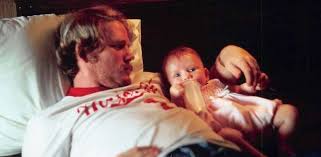 father’s heart. The forgiving father was not one who stood on convention and formality but was one who was present with and for his family. This is the model of fatherhood as described by Jesus and is the model presented in “Dads.”
Activities:
Discuss what does the description of God in the parable of the Forgiving Father mean to you?
Have you experienced God in this way?
Children: Call your father and father figures.
Share memories and experiences with your father.
Fathers: Share your memories of your father as well as memories of your time and experiences with your children.

 successful businessman who had connections with the Los Angeles and California business establishment. Even with the greater acceptance of successful black businesses, because of their race, Garrett and Morris faced limitations in the size and type of investment opportunities they could pursue and wealth they could build.
 The script is fast-moving and, given the importance of the subject, surprisingly full of lighter moments and humor. One of the major twists in the true story is most engaging, and though it could easily have been mishandled in the film, it seems genuine and not forced.
 In an interview with the director and co-screenwriter George Nolfi, I asked about the genesis of the story and his involvement. The details of Bernard Garrett’s career and his struggles against the systemic racism of his time were captured in taped interviews prior to his 1999 death. The rights to his life story were then purchased by another studio where the story languished for many years. While Nolfi was directing Anthony Mackie for a scene in The Adjustment Bureau, Mackie pitched The Banker to Nolfi for him to take on the project. As is often the case, other projects intervened and it was another five or six years before things fell together for the film.
 In making the film, Nolfi came face to face with the reality that without the opportunity to build wealth, people are unable to truly experience freedom and stability in their finances and life. He became more aware of the impact systemic racism had, and currently still has in society. Nolfi hopes this film will help viewers realize, that although they themselves may not be racist, the echoes and effects of systemic racism in the past and present continue to erect higher hurdles for persons of color. With such understanding, it will be easier to dismantle the surviving elements of systemic racism as well as the lasting impact from its past application. Nolfi also hopes that learning of the injustices these men faced, and their willingness to take them on and set in motion events that resulted in their eradication, others will be challenged and empowered to stand against current injustices and systemic hardships.
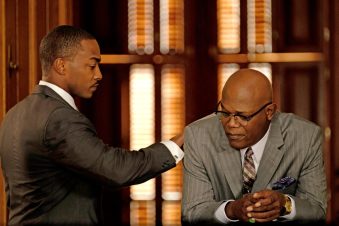 The Banker has several touchpoints with Scripture. As Moses was forced to leave his home in order to find peace and security and then after finding it was called to return to Egypt, (Exodus 2-4) Bernard escaped the land where, because of his skin color, intellect, and drive to succeed, he was a target. After Morris raised the risks associated with seeking to return and serve Blacks in his hometown, Bernard, like Moses, resisted the temptation to stay where he was, afraid of losing what he had, and returned home to help his community escape the indentured servitude that had confined them so long.

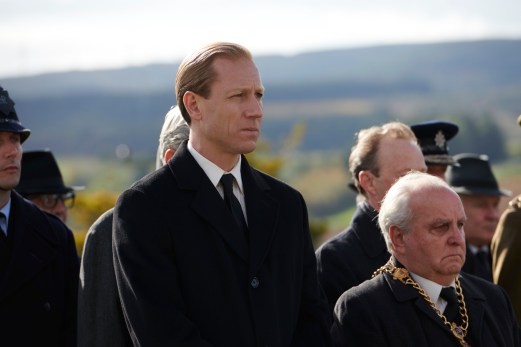


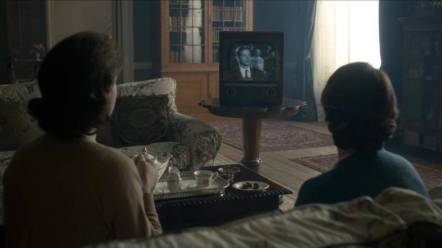 Queen Elizabeth (Claire Foy) and her mother Elizabeth (Victoria Hamilton) watch a news report of Billy Graham’s first Crusade in London. In his sermon Rev. Graham (Paul Sparks) defines revival as living out the teaching of Christ in one’s daily life through relationships with others. Part of revival includes living out a Gospel of hope in the certainty of God’s love and triumph rather than living a Gospel of despair in the midst of worldly uncertainty. This Gospel of hope extends to the individual, society, and all the world.
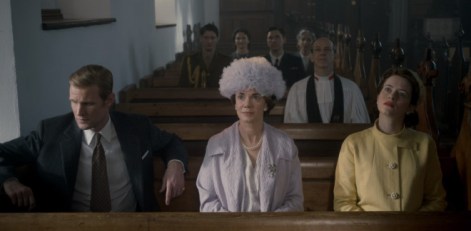 After hearing Rev. Graham preach on television, Queen Elizabeth invited him to preach at Windsor Castle. Following the worship service, Queen Elizabeth met privately with Rev. Graham where she expressed the pleasure it was for her to worship as Elizabeth, not as Queen and the head of the Anglican Church. She shared with Graham that it was her desire to be a “simple Christian.” As it turns out the idea of being a simple Christian is complicated. The Queen’s dilemma with her uncle and former King will reveal to her that being simply Christian is anything but simple.
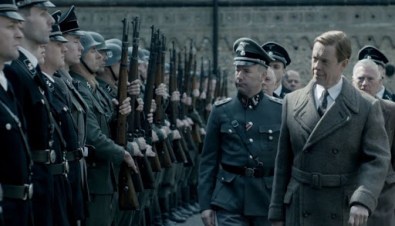 The Duke of Windsor’s (Alex Jennings) request to re-enter English society and service to the Crown and country led to the Queen’s discovery of the depth of Edward’s sympathies with and rumored support for Adolf Hitler and the Nazi party against his country and former subjects. With this new revelation, Queen Elizabeth struggled with the Christian command to forgive her Uncle. To assist in her struggle, the Queen asked for a second meeting with Billy Graham.
 In this meeting Elizabeth asks about forgiveness; “are there any circumstances do you feel where one can be a good Christian and yet not forgive?” Rev. Graham responds that “Christian teaching is very clear on this. No one is beneath forgiveness. Dying on the cross, Jesus himself asked the Lord to forgive those who killed him.” After a discussion on whether the forgiveness of those who crucified Jesus was conditional given they did not know what they were doing, Graham still maintained that and lack the strength and perfect love of Christ, as recipients of God’s forgiveness, it is required that Christians forgive. Although humans are mortal, Graham says, “We need not be unchristian ones.” Seeing the Queen struggle, Rev Graham offered a solution for her and all people. If there is someone she cannot forgive, she should “ask for forgiveness for herself, humbly, and sincerely, and then pray for the person she cannot forgive.”
  While holding on to anger can lessen the pain, it does not address nor reverse the effects of the harm. As pain relievers simply mask the symptoms of injury and can allow further damage to occur, so holding on to anger can lessen emotional pain in the short term but it damages one’s spirit.
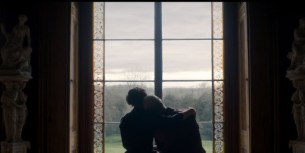 Although Elizabeth may have forgiven Edward, and other members of the family did forgive him, the consequences of his abdication were continued exile from his country and desire to serve. Edward, known to family and friends as David, shared with another King David the reality that though forgiven, he had to live with the consequences of his actions.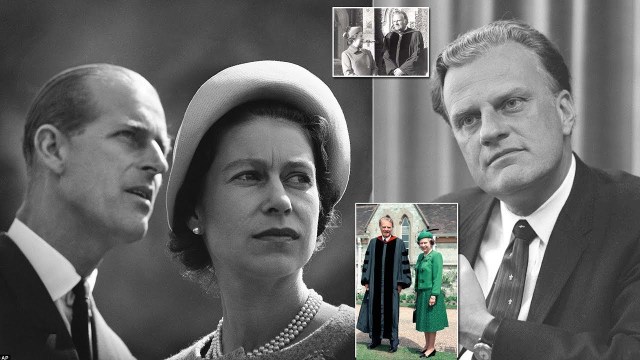


 THE ADVOCATES: Documenting the changing face and causes of homelessness in America, THE ADVOCATES presents the struggle to uphold a “care in community” ideal and serve this most vulnerable population amid a changing and increasingly punitive policy landscape. Set in Los Angeles, “Ground Zero” of the new homelessness in America, The Advocates follows three case managers from three social service organizations as they struggle to assist persons in finding housing, services, and security.
 AFTER THE END: Following the stories of people who have each experienced the death of a loved one, the film explores what it means to lose someone without losing ourselves in the process. The filmmakers journey across America, speaking with hospice coordinators, bereavement specialists and experts on grief counseling including: Alan D. Wolfelt, author, educator and founder of Center For Loss & Life Transition; and Rev. David M. Smith, as well as sharing archival video of Elizabeth Kubler-Ross, the author of the seminal work on grief issues, “On Death and Dying. Trailer:
  IMPRISONED: This prison thriller contrasts the transformative power of love and grace with the destructive power of hate and revenge. Dylan Burke (Juan Pablo Raba), inspired by the love of his life Maria (Juana Acosta), has moved on from his days as a criminal and become a successful and contributing member of his community where he works to help other ex-cons succeed in life after prison. His new life is interrupted by the vengeance of the new local prison warden, Daniel Calvin (Lawrence Fishburne) who has not forgiven Burke for an old crime. Though a non-fiction film, IMPRSIONED shows the real-life purpose of forgiveness and the consequences of holding on to anger and resentment. Rated R for violence, disturbing images, some sexuality and language. Trailer:
  SHADOW OF AFGHANISTAN: Although the site of the longest war in American history, the story of Afghanistan and its people remains a mystery to many Americans. This is the epic story of a nation’s history of war and occupation through the eyes of an Afghan warrior, independent filmmakers, and a small group of independent journalists, two of whom died covering this story. Twenty years in the making, the film documents the Soviet occupation, the exile, and the suffering of millions of citizens, a violent civil war and the fatal alliance of the Taliban with Al Qaeda. As one hears more of the history of Afghanistan, one understands better the Afghan people. Trailer: h
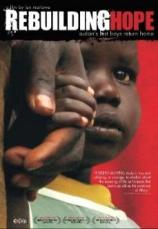 REBUILDING HOPE: Three boys fled their villages in South Sudan due to civil war, among thousands of others soon nicknamed “The Lost Boys” upon resettlement in the USA in 2001. Now in their 20’s, they return to Sudan to discover whether their homes and families have survived, what the current situation is, and how they can help their community rebuild. Rebuilding Hope is a powerful record of their quest to finding surviving family-members and rediscover and contribute to their homeland. It also sheds light on what the future holds for South Sudan in its precarious struggle for peace, development, and stability.
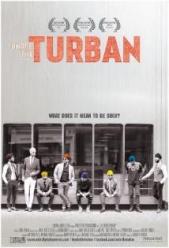 UNDER THE TURBAN: What makes one a Sikh? When nine-year-old Zara Garcha asks such a question, her family answers it in a most extraordinary manner—embarking on an international journey to learn about their heritage from modern-day Sikhs. From Italy to India to Great Britain, Argentina, Canada, and the US, Zara and her family traverse the globe and meet some of the most interesting, generous, and compassionate people on Earth. And in so doing, they remind us that, to fully understand our fellow human beings, we must judge not solely by what is on one’s head, but by what is in one’s heart. For Christians, ecumenical awareness not only increases knowledge of other faiths but also one’s knowledge and depth of the Christian faith. Trailer:
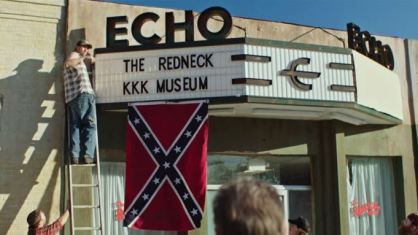 Upon reading the second story, Heckler drove to South Carolina and spent time with both the members of the church and black community as well as supporters of the museum. After his time in Laurens, getting to know the people involved, Heckler experienced the humanity of the members of the church and their supporters as well as the supporters of the shop and Klan. While he was not surprised to see the humanity of the former, he was surprised to see that the latter were not beasts, but rather humans who had the capacity to love and care, yet had been taught to hate and live life in anger and fear of others. Following this experience Heckler says he knew he had to make a movie telling the story.
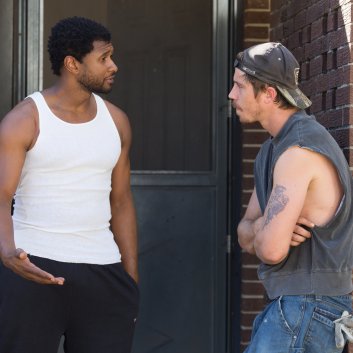 Burden starts out feeling like another cliché film about rednecks in a small southern town. Hedlund’s stilted, downcast performance is initially off-putting as it seems to be a caricature of a young illiterate southern “redneck.” As the film proceeds it is evident that Hedlund is not reflecting a lack of intelligence but rather Mike’s inner turmoil. Similarly,
 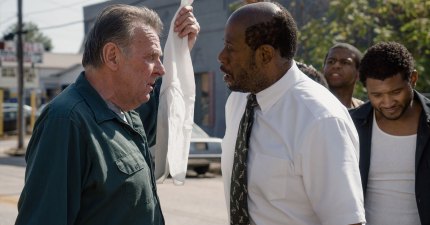 Forest Whitaker’s Rev. Kennedy succeeds in reflecting the reluctance that often accompanies righteousness. While Kennedy knows his Lord is calling him to offer love and forgiveness to those who are persecuting him, his family, and his community, he also feels his human instinct to reject this calling. For Kennedy, this also carried personal weight as his great uncle was lynched in Laurens by the Klan (Photo below). Rev. Kennedy’s decision to offer grace and support only makes sense through his faith in the ways of God and life in God’s Kingdom. What initially seemed to be another film empty of anything but stereotypes, Burden ends as a powerfully presented parable of the promise and perils of seeking redemption as well as offering grace and love to those who repent and ask for forgiveness.
 That Burden was a labor of love is appropriate to the themes of confession, grace, and forgiveness being the pathway for redemption. Forgiveness and grace, if offered as Jesus commands, is nothing short of a literal labor of love. The film depicts in no uncertain terms the difficulty of loving others in the way Jesus loves and expects His followers to love and live. Following Jesus and loving one’s enemies means not only standing against the hate of one’s enemies, but perhaps also standing against the anger and resentment of one’s family, friends, and community.
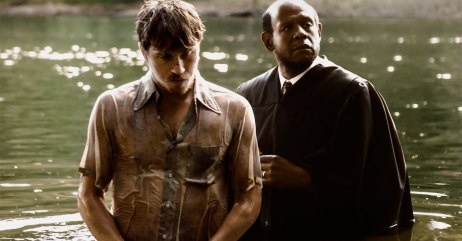 In the conclusion to my conversation with Andrew Heckler I shared with him that the film, particularly the ending reminded me of the vows of Baptism I confirmed for myself as a youth, and as a United Methodist pastor have asked others coming for baptism into the ministry and church of Jesus Christ. Burden depicts the living out of these vows, and the challenges inherent in being a disciple of Jesus.
 These are the expectations Christ has for membership in His Church and these are the challenges and actions Mike Burden faced when he sought to repent from a life of hate and accept the love, grace, and redemption from God and those he persecuted. These are also the expectations Christ has for Rev. Kennedy when presented with the opportunity to offer grace and love to those who have and seek to persecute him and his family. At times living by these vows will be a burden for all disciples, yet God supplies faith to follow them, and grace when one stumbles and then repents.
 From its earliest days, films have depicted people and the lives they live. December 28th 1895 is considered the birthday of cinema as Luis and Auguste Lumière first projected a moving image onto a screen, a train pulling into the station in La Ciotat France. The image was captured by the Lumieres when they placed their
  In his film 1917, writer/director Sam Mendes takes the audience back in time as he shows people struggling through a horrendous place and time, the Western Front during World War 1. 1917 depicts two British infantrymen given a most dangerous mission, to work their way beyond the trenches through “no man’s land,” into and through territory the Germans had just evacuated yet was likely still populated by pockets of enemy soldiers, and deliver a message to save 1600 men from a German ambush. Although the story is about the two men on a dangerous mission, there is a third person on the journey, the viewer. Mendes’s goal in the film is to expose the audience to the experience of one of the most brutal and tragic events of the 20th Century, “The Great War.”
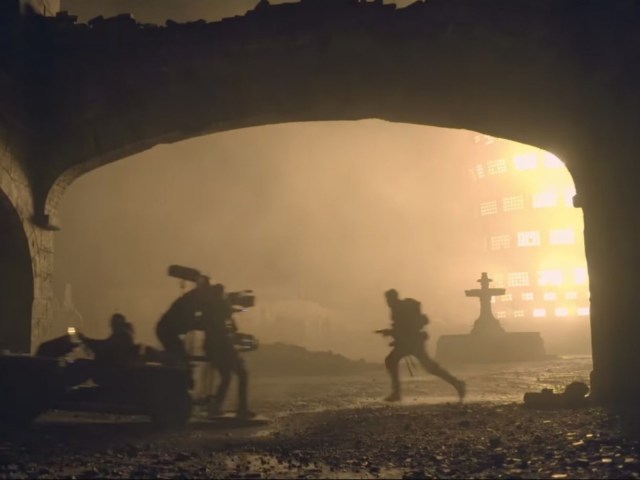 To increase the sense of the viewer’s being there, Mendes uses a series of very long, single-shot sequences that give the feeling that the film is taking place in real-time. Other directors have sought to make films to appear as one shot, but none have attempted it on such a grand scale. While the Lumière brothers set up their static camera on the La Ciotat train platform, Mendes snakes his camera through the trenches, battlefield, bombed-out farm, and war-torn city, showing the viewers where the war was fought and where soldiers and non-combatants lived and died. Although the energy of the film is experienced in the combat sequences, Mendes offers glimpses into the other experiences of war, the downtime boredom, hunger, and human connections that arise when people of different lives, cultures, families, and nations are thrown together.
 While Mendes is rightly receiving praise, and awards (Golden Globe Winner for Best Direction) much of the weight of the film rests on the shoulders of the two leading characters, Lance Corporal Blake (Dean-Charles Chapman) and Lance Corporal Schofield (George MacKay.) Regardless of the technical wizardry, masterful sets, planning, and direction, the success of the film depends mostly on the ability of Chapman and Schofield to grab the audience’s attention and keep it for the entirety of the two-hour film.
 MacKay and Chapman deliver powerful performances conveying an array of emotions including cynicism forged in the fog of battle and the mistakes of command, courage amidst fear, tender generosity within utter brutality, and determination to fulfill the mission and keep a promise. While both actors more than accomplish this, MacKay should be in conversations for best actor awards. Colin Firth (General Erinmore) and Benedict Cumberbatch (Col. Mackenzie) lead a large supporting cast, who given the fluid nature of the film, appear briefly in single scenes. Claire Duburcq, as the only woman in the cast, offers a touching performance as a young woman trapped by the fighting in what was once her home town.
 Another masterful accomplishment in 1917 is the production design (Dennis Gassner) and staging. The moment Blake and Schofield go over the wall of the trench into no man’s land they enter a world as alien as another planet, and they take the viewers with them. All around is death, whether it be the bomb craters, tangled, flesh-hungry barbed wire, human and equine corpses, or the foraging rats which, although alive, represent death. Death also lingers beyond no man’s land, but it is mixed with the signs of life and nature that seem to mockingly remind the combatants and viewer of the goodness and beauty of life that used to flourish.
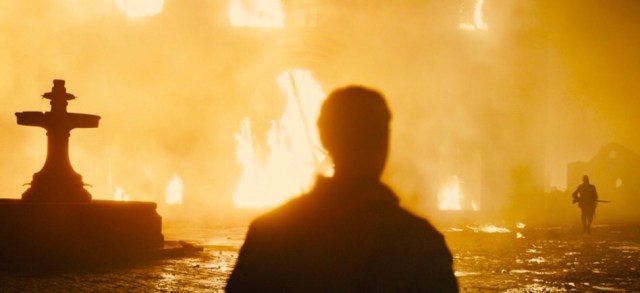 Viewers familiar with the war film genre will recognize elements of other war films. Echoing Paul in the World War 1 Film All Quiet on the Western Front, Schofield shares how the war has changed him and more importantly, his experience of home. There is also the tension of urban combat where the enemy could be around every turn and in every bombed-out window as shown in Full Metal Jacket and American Sniper among others. There are the surreal sensory experiences that accompany the transformation of a typical town into a monstrous battle jungle, and humanity into a beastly caricature depicted in Apocalypse Now. From Saving Private Ryan there is going forward on a seemingly impossible mission as well as the intimate nature that can accompany the life and death struggle of hand to hand combat. The extended tracking shots also recall the film signature of Stanley Kubrick in his World War 1 masterpiece, Paths of Glory as well as the earlier mentioned Full Metal Jacket.
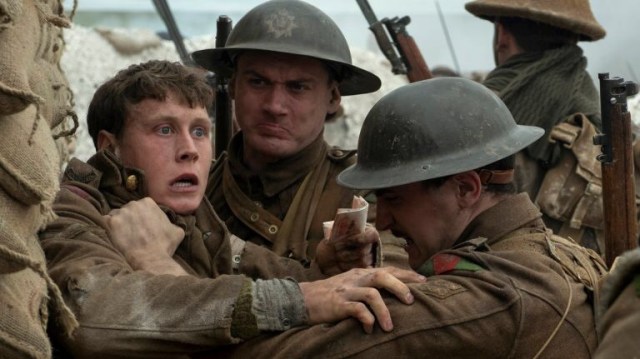 Given the intimacy and real-time presentation of 1917, the viewer feels perhaps the most difficult part of surviving combat, leaving behind those who fall. What is the most personal and solemn occasion in life is often hardly noticed on the battlefield. When death comes in wave after wave there is little, if any time to mourn the loss nor sanctify the place of the fallen. Combat does not allow for such luxuries as another fight seems always to be calling.
 Greta Gerwig’s film adaptation of Louisa May Alcott’s beloved book Little Women deserves the accolades and overwhelmingly positive reviews it has received. There is probably no greater challenge in filmmaking than adapting beloved literary works. Typically there have already been film adaptations as well as the original book against which the film will be measured on both artistic and emotional levels.
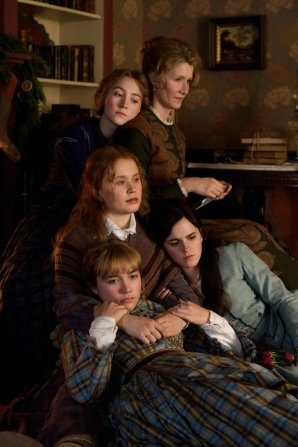 Set during the American Civil War, Little Women is a story of family love, hope in the face of challenges, and the power of community to support, nurture and overcome life’s trials. Led by the untiring matriarch Marmee, the March family endures anxiety of the absence of the father who went to war as well as the day to day financial challenges of a family now without a primary source of income. In the midst of these and other challenges, the sisters maintain their close bonds. In addition to their commitment to each other, the family learns through their mother to respond to the call to serve others who are less fortunate and equipped to endure hardship and want. Marmee models that serving does not begin until the service and giving are sacrificial. Even when such service calls to them to make greater than anticipated sacrifices, including the ultimate sacrifice, they retain their spirit and refrain from sliding into bitterness and anger that accompanies loss and grief.
 Saoirse Ronan makes the perfect Jo as she commands full attention whenever she is on screen, and even sometimes when she is not. Saoirse does not take all the oxygen in her scenes, she is the oxygen. Florence Pugh also offers a strong performance as Amy, the artist sister and, as Aunt March (Meryl Streep) christens her, the family’s “only hope” to marry well and assure the family’s financial and social status. Eliza Scanlen depicts the fragile Beth with the right amount of delicacy and vulnerable innocence. Emma Watson is functional if a bit young as older sister Meg. Laura Dern shows appropriate strength and miracle worker talents as Marmee, the mother and chief cat-herder of the rambunctious four sisters. The supporting cast, led by Meryl Streep, Chris Cooper, and Bob Odenkirk are, unsurprisingly, strong and greatly add to the nuance and depth of the story.
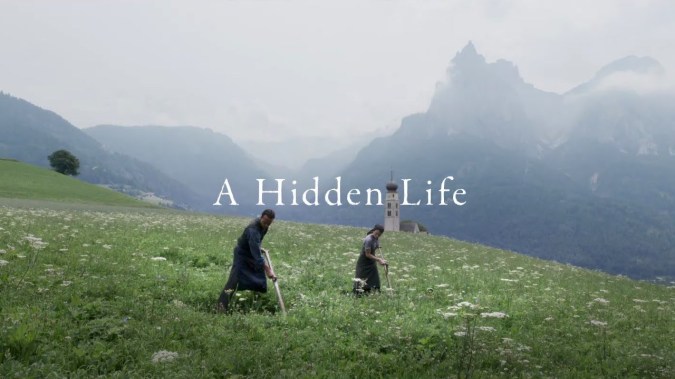 For those who imagine what would have happened if the SS monsters chasing The Von Trapp family in The Sound of Music had captured them in the Abbey’s graveyard, Terrence Malick’s latest virtuosic film, A Hidden Life offers a possible answer, if Captain Von Trapp had stuck to his convictions.
 Although filmed in the Dolomite Mountains of Italy, A Hidden Life depicts the lush pastoral countryside and village of St. Radegund Austria, the home of Franz, his wife Franziska (Valarie Pachner) and his young daughters. Malick does not let any of the indescribable beauty of the Alps go to waste. Cinematographer Jörg Widmer captures the area in such a way that the viewer has the sense they are at one with the landscape and therefore experience a greater connection to the story and film. With but a bit of imagination, the viewer feels both the flowing beauty and peace of the setting.
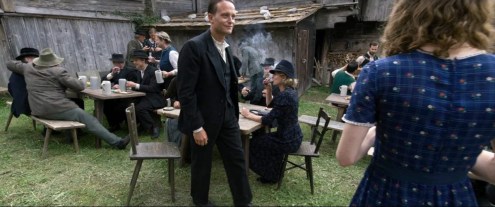 The viewer might also experience the simple, communal, and peaceful life of St. Radegund as presented at the beginning of the film. Initially, the community was close nit as families cared for and worked with one another to make a life together and help supply food and dairy products for the nation. This bucolic life and sense of community, however, falls victim to the Anschluss of Austria into Germany on March 12th, 1938 and the beginning of World War II.
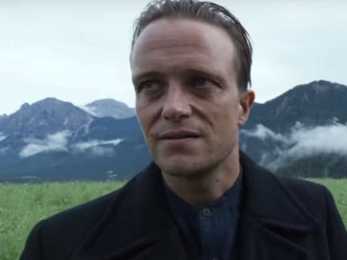 As he did with the scenery, the director also focuses on the characters. In contrast to the vastness of the pastures and mountains, Malick frequently photographs the individuals in tight shots, seemingly violating personal space boundaries. Such intimacy in shot selection symbolizes the personal nature and effects of the characters’ decisions and actions. The technique also pulls the viewer further into the narrative, making them more of a witness than a distant, disconnected observer.
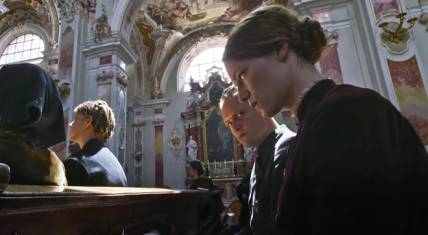 adhere to his belief, or declare, if only in words, the allegiance. F
 Franz Jäggerstätter took John 12:25-26 and other teaching and life examples of Jesus and early followers with most seriousness as he believed that to swear an oath, if only in word, to Adolph Hitler was to join the Peter by the campfire when the Apostle denied his Lord. For Franz, the issue was less about losing his salvation than about betraying his creator and redeemer. Though he became known for his struggle and sacrifice, the title of the film acknowledges Franz was not alone in his decision. Through the centuries there have been many hidden lives that chose righteousness over life in this world.
 Throughout the film, Franz resisted offering judgment against those who had given their loyalty to Hitler. It was a personal matter and decision. For Franz, his resistance mattered because he believed it mattered. In his heart, he believed that to offer his loyalty to Hitler was to take it from Jesus. If others did not agree with his belief, Franz withheld judgment. This refusal to judge others extended beyond the screen and into the theater. It is difficult to imagine anyone could watch the film without asking, “What would I do?” As the viewer asks and considers this question while watching Franz wrestle with his dilemma, one senses Franz would call the viewer not to do what he is doing, but to do what the viewer, after intentional discernment, believes God desires them to do.
 Although he has a devoted following, Terrence Malick is not every film lover’s cup of tea. As much as any working director, viewers either take or leave Malick’s films, and A Hidden Life, will prove to be no exception. Whether it is the challenging nature of the story or the slowly evolving, three-plus hours length, there will be many for whom this bell will not toll. But for those who appreciate or savor deeply personal storytelling, superb Oscar-worthy acting, and unsurpassable cinematic beauty, A Hidden Life is not a film to miss.

 investigative reporter, Vogel is resistant to accept the assignment to interview a man who is known for his sugar-sweet children’s TV program. Later, Vogel discovers that all of the other “Hero” subjects refused to allow him to interview them because of his reputation for attacking the subjects of his stories. Mr. Rogers not only agreed to allow Vogel to do the interview but Rogers sought him out.
 In order to be able to love a neighbor, one has to take time to see and get to know them. Where the other Heroes of the Esquire spread saw Vogel as an attack journalist who wrote with a laptop as well as a hatchet, Rogers saw Lloyd as someone living an angry, pain-filled life. Taking the time to literally read between the lines, Rogers saw in Lloyd someone who had life-wounds that were still raw. Upon recognizing this anger and injury, Mr. Rogers shared more than just information about himself with Vogel, he shared himself by establishing a relationship with Lloyd. As with any friendship, Fred took a risk in sharing who he was and what he believed. One of the most important depictions of “Beautiful Day” was Fred Rogers had the rare attribute that he was what he believed. And, what Fred believed was that all persons are special children of God who deserve to be loved and cared for, especially when they are wounded and even angry. For Fred, and all persons of faith, a difficult personality or situation does not release one from their duty to care for others and in doing so, share God’s peace.
 In addition to a commitment to love one’s neighbors whether they be next door, family, friends, strangers, and even enemies, A Beautiful Day in the Neighborhood also depicts Fred Rogers’s living a peace-filled and peace-filling life. While many, including Lloyd, assume that the persona of Mister Rogers is a role for Fred Rogers, Lloyd and the audience discover that the man and the character are the same. Fred Rogers truly lives life at peace, even in the midst of a world that is so often in conflict. Put in a theological perspective, Fred lives a life of Shalom, peaceful wholeness even in the midst of tremendous conflict and uncertainty.
 By risking and reaching out to someone he knew was struggling, Fred Rogers helped Lloyd
 CrossRoads Faith and Film